
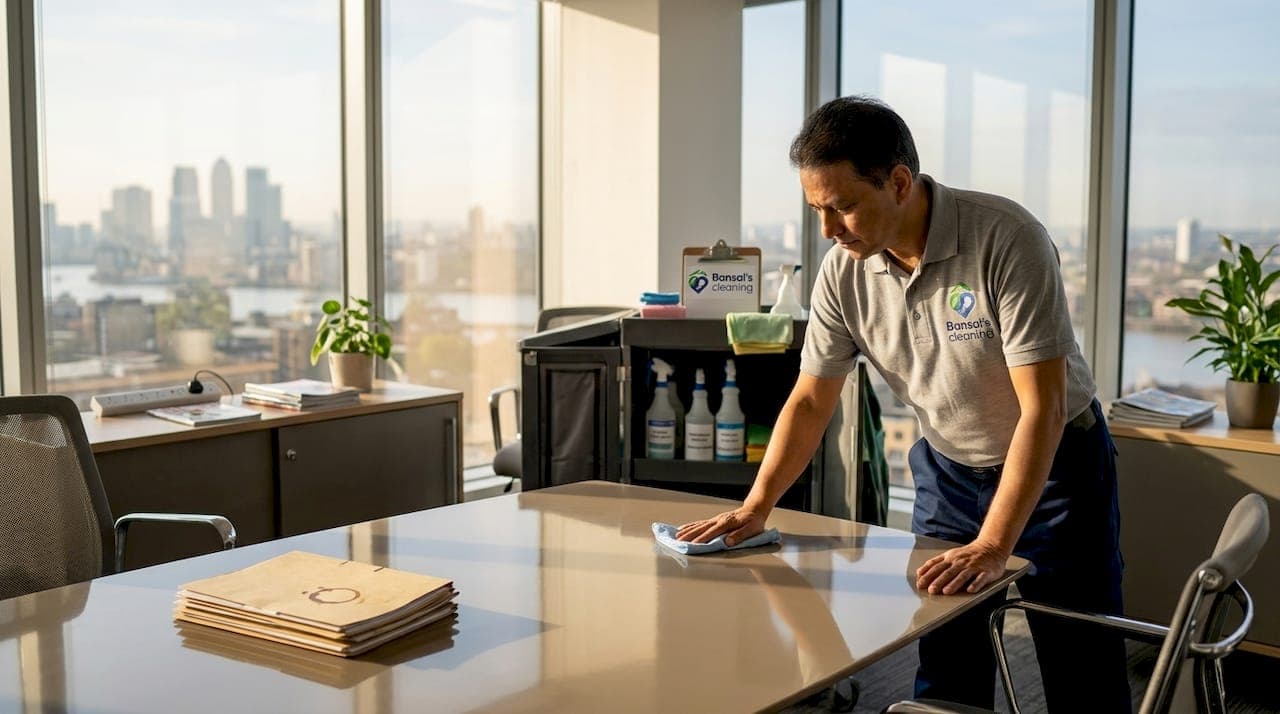
Many Essex business owners believe commercial cleaning is simply tidying offices or mopping floors, but this misunderstanding can lead to inadequate hygiene standards and wasted budgets. Professional commercial cleaning involves systematic processes, environment-specific methods, and measurable standards that go far beyond basic housekeeping. Whether you manage an office, restaurant, or retail space in Essex, understanding the core principles of commercial cleaning helps you make informed decisions about service quality, frequency, and cost. This guide clarifies the essential methods, standards, and expert practices that define effective commercial cleaning for your business premises.
Table of Contents
- The Core Steps And Methods Of Commercial Cleaning
- Understanding Cleanliness Standards And Verification
- Critical Distinctions: Cleaning, Sanitising And Disinfecting
- Common Challenges And Expert Approaches In Commercial Cleaning
- Professional Commercial Cleaning Services In Essex
- Frequently Asked Questions
Key takeaways
| Point | Details |
|---|---|
| Systematic process | Commercial cleaning follows a top-to-bottom sequence with environment-specific methods for offices, restaurants, and other commercial spaces. |
| Cleanliness standards | ISSA defines five appearance levels with ATP testing for objective measurement, helping property managers verify quality. |
| Three distinct approaches | Cleaning removes dirt, sanitising reduces bacteria, and disinfecting kills viruses, each serving different hygiene goals. |
| Common pitfalls | Incorrect chemical dilution, bottom-up cleaning, and skipped audits undermine results and require expert procedures to prevent. |
| Professional verification | Regular audits, transparent reporting, and adherence to recognised standards ensure consistent hygiene outcomes. |
The core steps and methods of commercial cleaning
Professional commercial cleaning involves systematic processes that prevent recontamination and maximise hygiene outcomes. The sequence begins with assessing clutter and removing obstacles, followed by dusting high surfaces like light fixtures, vents, and shelving units. This top-to-bottom approach ensures dirt and debris fall onto uncleaned lower areas rather than settling on freshly cleaned surfaces. Cleaners then address horizontal surfaces, high-touch points, and finally floor care, creating a logical workflow that saves time and improves results.
Environment-specific methods vary significantly across commercial settings. Office cleaning prioritises high-touch surfaces like keyboards, phones, door handles, and shared equipment to reduce microbial transmission among staff. These areas harbour bacteria and viruses that spread illness, making regular attention essential for workplace health. Cleaners use microfibre cloths and appropriate disinfectants, allowing proper dwell time to achieve pathogen kill rates specified by manufacturers.
Restaurant environments demand tougher degreasing and food-safe sanitisers due to cooking residues and regulatory requirements. Kitchen staff disassemble equipment like fryers and grills for thorough cleaning, removing trapped grease and food particles that attract pests and harbour harmful bacteria. Floor care in restaurants requires specialised degreasers that cut through oil buildup without damaging tile or grout, followed by sanitising solutions approved for food preparation areas.
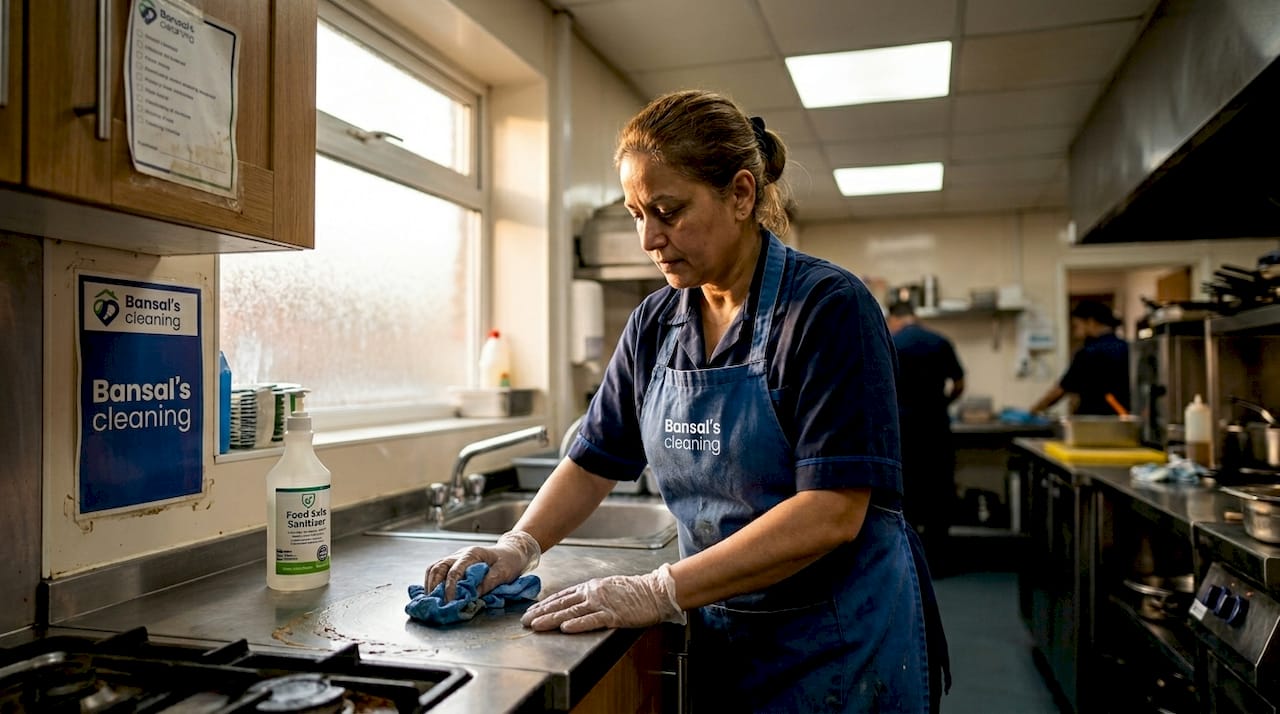
Proper disinfectant application requires understanding dwell time, the period a chemical must remain wet on a surface to kill pathogens effectively. Many disinfectants need five to ten minutes of contact time, yet rushed cleaning often wipes surfaces dry within seconds, rendering the product ineffective. Professional cleaners follow manufacturer guidelines precisely, ensuring chemicals work as intended.
Floor care rounds out the cleaning process with pH-neutral products that preserve surface integrity whilst maintaining hygiene. Acidic or alkaline cleaners can damage flooring materials over time, creating dull spots or etching that traps dirt and bacteria. Regular maintenance using appropriate solutions extends floor life and keeps commercial spaces looking professional.
The systematic approach includes these core steps:
- Initial assessment and decluttering to prepare work areas
- High dusting of ceiling fixtures, vents, and upper surfaces
- Cleaning and disinfecting horizontal surfaces and high-touch points
- Detailed attention to environment-specific needs like kitchen equipment
- Floor care with appropriate products and techniques
- Final inspection and quality verification
Each step builds on the previous one, creating comprehensive cleanliness that meets commercial standards and protects occupant health.
Understanding cleanliness standards and verification
The ISSA Clean Standards define five appearance levels that help property managers specify and measure cleaning quality objectively. Level 1 represents orderly tidiness with minimal soil, whilst Level 5 approaches cleanroom conditions with virtually no visible contamination. Most commercial offices operate at Level 2, balancing quality with cost-effectiveness for everyday business environments. This level allows minor soil accumulation in low-traffic areas whilst maintaining clean, professional appearances in client-facing spaces.
ATP testing measures adenosine triphosphate, an organic molecule present in all living cells, providing objective data about surface cleanliness. Swabs collect samples from surfaces, and portable readers quantify ATP levels in relative light units (RLUs). Lower readings indicate cleaner surfaces, though ATP testing doesn't identify specific pathogens or distinguish between harmful bacteria and harmless organic residue. A kitchen countertop might show high ATP from food residue without necessarily harbouring dangerous microbes.
Surface type significantly affects ATP readings, making standardised benchmarks challenging. Porous materials like wood or fabric naturally retain more organic matter than smooth stainless steel or glass, producing higher readings even when properly cleaned. Professional cleaning services establish baseline readings for different surfaces and track trends over time rather than relying on absolute thresholds.
Increasing cleanliness levels from 2 to 1 typically adds 15 to 25 percent labour cost per square foot, as more frequent attention and detailed work become necessary. Property managers must weigh these costs against business needs, considering factors like client impressions, health regulations, and employee wellbeing. A medical office justifies higher standards than a warehouse, whilst a luxury hotel lobby demands more attention than back-of-house storage areas.
Budget considerations influence cleaning service level decisions significantly. Understanding the relationship between appearance levels, verification methods, and costs helps you allocate resources effectively. Some businesses maintain Level 2 standards generally whilst elevating high-visibility areas to Level 1, creating a tiered approach that balances quality and economy.
Pro Tip: Use ATP testing alongside visual inspections and customer feedback to build a complete picture of cleaning effectiveness. No single metric tells the whole story, but combining objective data with subjective observations ensures consistent standards.
Verification tools include:
- Visual inspections using standardised checklists
- ATP testing for quantifiable surface cleanliness data
- Customer satisfaction surveys capturing user experience
- Photographic documentation tracking progress over time
- Third-party audits providing independent quality assessment
These complementary approaches create accountability and help cleaning teams maintain the specified appearance level consistently across all areas of your commercial property.
Critical distinctions: cleaning, sanitising and disinfecting
Understanding the differences between cleaning, sanitising and disinfecting proves essential for specifying appropriate service levels and achieving hygiene goals. Cleaning focuses on removing visible soil, dust, and debris from surfaces using detergents and mechanical action. This process reduces dirt and some microorganisms but doesn't necessarily kill pathogens. A cleaned desk looks tidy and feels fresh, yet bacteria and viruses may still be present at levels that could transmit illness.
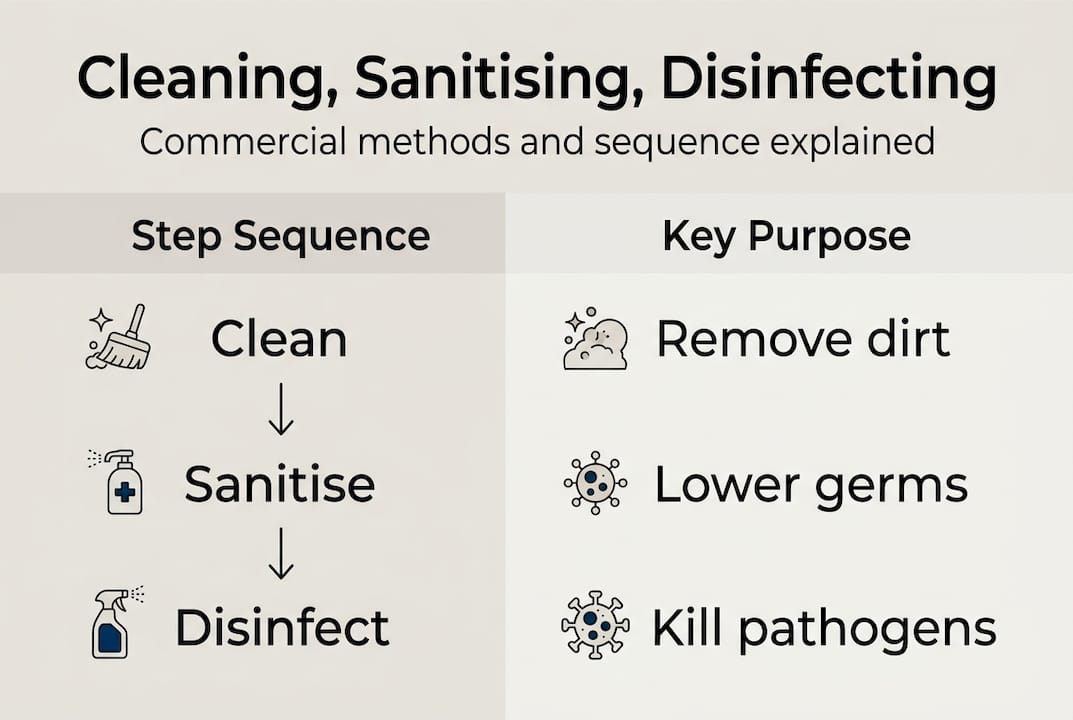
Sanitising lowers bacterial counts to levels deemed safe by public health standards, typically reducing bacteria by 99.9 percent within a specified timeframe. Food service areas require sanitising after cleaning to meet regulatory requirements, using approved chemicals at proper concentrations. Sanitisers work quickly, often within 30 seconds to one minute, making them practical for high-turnover environments like restaurant tables between customers.
Disinfecting eliminates a broader spectrum of pathogens including viruses, fungi, and more resilient bacteria that sanitisers might miss. Disinfectants require longer contact times, often five to ten minutes, and use stronger chemical formulations. Medical facilities, childcare centres, and food preparation areas benefit from disinfecting protocols that provide higher levels of pathogen control than sanitising alone.
The proper sequence matters enormously for effectiveness. Surfaces must be cleaned before sanitising or disinfecting, as organic matter and debris interfere with chemical action. Dirt particles shield microorganisms from disinfectants, reducing kill rates and wasting product. Professional cleaners always remove visible soil first, then apply sanitisers or disinfectants to prepared surfaces.
Budget constraints often force choices between cleaning-only services and higher-standard approaches incorporating sanitising or disinfecting. Businesses must assess risk levels and regulatory requirements when deciding which approach suits different areas. Reception areas might need only regular cleaning, whilst kitchen surfaces demand sanitising and toilets require disinfecting.
| Approach | Purpose | Pathogen reduction | Dwell time | Typical use |
|---|---|---|---|---|
| Cleaning | Remove visible soil | Some reduction | Immediate | General surfaces |
| Sanitising | Reduce bacteria | 99.9% bacteria | 30-60 seconds | Food contact areas |
| Disinfecting | Kill viruses/pathogens | 99.999% broad spectrum | 5-10 minutes | High-risk zones |
Pro Tip: Prioritise disinfecting in high-risk areas like toilets, kitchen prep surfaces, and medical examination rooms, whilst using sanitising for dining areas and cleaning for low-touch office spaces. This tiered approach optimises both hygiene and budget.
Chemical selection impacts both effectiveness and safety. Food-safe sanitisers use quaternary ammonium compounds or chlorine solutions approved for surfaces that contact edibles, whilst medical-grade disinfectants employ stronger formulations unsuitable for food areas. Professional services match chemicals to environments, ensuring regulatory compliance and occupant safety.
Application technique affects outcomes as much as product choice. Spray-and-wipe methods often fail because cleaners remove disinfectants before dwell time completes. Proper protocols involve applying product, allowing it to remain wet for the specified duration, then wiping or rinsing as directed. This discipline separates amateur efforts from professional results.
Common challenges and expert approaches in commercial cleaning
Incorrect chemical dilution represents one of the most frequent commercial cleaning problems, weakening cleaning power when too dilute or damaging surfaces when too concentrated. Manufacturers specify precise ratios for effectiveness and safety, yet rushed or untrained staff often guess at measurements. Overly strong solutions can etch floors, fade fabrics, or leave residues that attract dirt, whilst weak mixtures fail to remove soil or kill pathogens. Professional services use calibrated dispensing systems that ensure consistent dilution every time.
Cleaning from bottom to top creates the recontamination problem that systematic approaches avoid. When cleaners start with floors and work upward, dust and debris from higher surfaces fall onto freshly cleaned areas, forcing redundant work and leaving inconsistent results. This backwards sequence wastes time and products whilst frustrating both cleaners and clients. Training emphasises the logic of gravity and workflow efficiency.
Skipping regular audits allows quality to drift unnoticed until clients complain or health inspections reveal problems. Without verification systems, cleaning teams may cut corners, miss areas, or fail to maintain standards during busy periods. Detailed service descriptions and accountability measures prevent these lapses by establishing clear expectations and regular checkpoints.
Solutions centre on standard operating procedures that document every task, product, and technique in detail. Written SOPs remove ambiguity and provide training references for new staff, ensuring consistency regardless of personnel changes. Checklists convert procedures into daily accountability tools, with cleaners signing off completed tasks and supervisors verifying quality.
Technology-driven solutions include mobile apps that guide cleaners through tasks, capture photographic evidence, and timestamp completions. These systems create audit trails that protect both service providers and clients, documenting exactly what was done and when. Real-time reporting alerts managers to missed tasks or quality issues before they escalate.
Pro Tip: Choose a cleaning service that provides transparent reporting, uses standardised procedures, and welcomes third-party verification. These practices indicate professionalism and commitment to consistent quality.
Common pitfalls and solutions include:
- Wrong dilution ratios: Install calibrated dispensing systems
- Bottom-up cleaning: Train staff in systematic top-to-bottom workflows
- Skipped audits: Implement regular quality checks and documentation
- Inadequate training: Provide ongoing education and certification programmes
- Poor communication: Establish clear channels between clients and cleaning teams
Addressing these challenges requires commitment from both service providers and property managers. Clients who understand cleaning principles can specify requirements clearly and recognise quality work, whilst professional services that invest in training and systems deliver consistent results that justify their fees.
"The difference between adequate and excellent commercial cleaning lies not in effort but in systems. Proper procedures, training, and verification turn hard work into measurable results that protect health and enhance business environments."
Expert approaches recognise that commercial cleaning is a skilled profession requiring knowledge of chemistry, microbiology, and workflow management. Treating it as unskilled labour leads to poor outcomes, whilst respecting the expertise involved produces environments that support business success and occupant wellbeing.
Professional commercial cleaning services in Essex
Navigating the complexities of commercial cleaning standards, methods, and verification becomes simpler when you partner with experienced professionals who understand these principles deeply. Bansal's Cleaning offers expert commercial cleaning tailored to offices, restaurants, and diverse commercial spaces throughout Essex, applying the systematic approaches and quality standards detailed in this guide.
Our services focus on measurable hygiene outcomes, professional appearance, and compliance with recognised industry standards. We implement the top-to-bottom cleaning sequences, environment-specific methods, and proper chemical protocols that distinguish professional results from amateur efforts. Whether you need daily office maintenance, deep restaurant cleaning, or specialised services for unique commercial environments, our trained teams deliver consistent quality backed by transparent reporting and verification systems. Flexible service packages accommodate various types of cleaning needs, from regular maintenance to intensive deep cleans and emergency response. Contact Bansal's Cleaning today to discuss how our proven office cleaning processes and commercial expertise can maintain the hygiene and appearance your Essex business deserves.
Frequently asked questions
How often should commercial properties be professionally cleaned?
Frequency depends on business type, foot traffic, and specific hygiene requirements for your industry. Offices typically benefit from daily to weekly cleaning depending on occupancy and client visibility, with high-traffic reception areas needing more frequent attention than private offices. Restaurants require daily cleaning as a minimum, with kitchen areas often needing multiple cleanings per shift to maintain food safety standards and regulatory compliance.
What is ATP testing and how reliable is it for verifying cleanliness?
ATP testing measures organic residue on surfaces by detecting adenosine triphosphate, providing objective numerical data about cleanliness levels. It's a helpful verification tool but varies significantly by surface type and doesn't identify specific harmful pathogens, so it works best as part of a broader quality assurance programme. Use ATP readings to track trends over time rather than relying on absolute thresholds, combining this data with visual inspections and customer feedback for comprehensive quality assessment.
What's the difference between sanitising and disinfecting in commercial cleaning?
Sanitising reduces bacterial levels to amounts deemed safe by public health standards, typically achieving 99.9 percent reduction within 30 to 60 seconds. Disinfecting kills a broader spectrum of pathogens including viruses and more resilient microbes, requiring longer contact times of five to ten minutes and stronger chemical formulations. Choosing between them depends on risk level and area use, with food contact surfaces requiring sanitising and high-risk zones like toilets needing disinfecting.
Are eco-friendly cleaning products effective in commercial environments?
Eco-friendly products can be highly effective when formulated properly and used according to manufacturer guidelines, with many meeting the same industry standards as traditional chemicals. They often provide safer indoor environments by reducing volatile organic compounds and harsh chemical exposure, whilst aligning with sustainability goals that enhance business reputation. Professional services like eco-friendly carpet cleaning demonstrate that environmental responsibility and cleaning effectiveness aren't mutually exclusive when expertise guides product selection and application.